You Won’t Believe What I Ate in Gondar
Gondar, Ethiopia, is more than ancient castles and mountain views—it’s a hidden food paradise waiting to be discovered. I went expecting history, but left obsessed with flavors I never imagined. From spicy stews simmered for hours to injera that tastes like home, the specialty dining scene here is deeply authentic. This isn’t just eating; it’s experiencing culture on a plate.
Arrival in Gondar: First Impressions Beyond the Castles
The moment I stepped off the bus in Gondar, the crisp highland air wrapped around me like a familiar blanket. At over 7,000 feet above sea level, the city rests in a valley surrounded by misty hills and ancient volcanic ridges. The sky feels closer here, the sunlight clearer, and the pace of life measured not by clocks but by the rhythm of daily rituals. My first glimpse of Fasil Ghebbi—the 17th-century royal fortress complex—was breathtaking, its turrets and stone walls rising like a fairy-tale castle carved from volcanic rock. But within hours, I realized that Gondar’s soul wasn’t just in its monuments. It was in the scent of roasting spices drifting from open doorways, in the laughter echoing from family courtyards, and in the warmth of an invitation I received before I’d even checked into my guesthouse.
A woman named Alemitu, who ran a small shop near the market, noticed me looking at a basket of yellow spices. She smiled, gestured for me to follow, and led me through a narrow alley to her home. Inside, her mother was stirring a pot over a clay stove, and the aroma—smoky, spicy, deeply earthy—filled the room. Without hesitation, she set a place for me. That first meal, eaten cross-legged on a woven mat, changed everything. I had come to see ruins, but I was already being welcomed into a living tradition. The food was rich, fiery, and unlike anything I’d tasted in Addis Ababa. It was then I understood: to know Gondar, you must eat like a Gondarine.
The Heart of Ethiopian Flavors: Understanding Local Cuisine
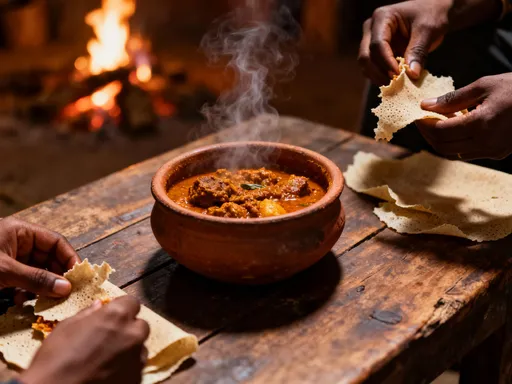
Ethiopian cuisine is often celebrated for its bold flavors and communal style, but in Gondar, those elements feel especially rooted in daily life. The foundation of most meals begins with a few essential ingredients: berbere, a fiery spice blend of chili peppers, garlic, ginger, and more than a dozen aromatic spices; niter kibbeh, spiced clarified butter infused with herbs like basil and cardamom; and teff, the ancient grain used to make injera, the spongy, sourdough flatbread that serves as both plate and utensil. These are not exotic novelties—they are the lifeblood of home cooking, passed down through generations.
What makes Gondar’s approach to food unique is how climate and history have shaped its culinary identity. Nestled in the northern highlands, the city experiences cool temperatures and strong seasonal shifts. This environment favors slow-cooked, hearty dishes that provide warmth and sustained energy. Meals are often prepared over a mesob—a traditional clay stove—and left to simmer for hours, allowing flavors to deepen. Fermentation, too, plays a crucial role. Injera dough ferments for up to three days, giving it a tangy depth that balances the heat of spicy stews. This is not fast food; it’s food made with patience, intention, and care.
Equally important is the culture of sharing. Meals in Gondar are rarely eaten alone. Families gather around a single large platter, tearing off pieces of injera to scoop up wats (stews) together. This act of communal eating is more than practical—it’s symbolic. It reflects values of unity, generosity, and respect. Even more telling is the coffee ceremony, a ritual that can last over an hour. Green coffee beans are roasted over a flame, ground by hand, and brewed in a jebena (clay pot). The process is repeated three times, each round symbolizing a different blessing: pleasure, strength, and blessing. To be invited to this ceremony is to be considered family.
Dining Like a Local: From Street Stalls to Hidden Courtyard Eateries
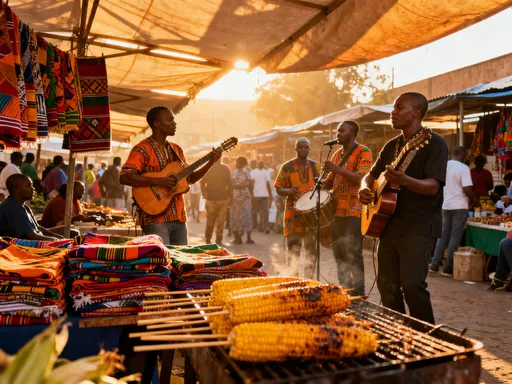
Tourists often search for restaurants with signs, menus in English, or online reviews. But in Gondar, the best meals are found in places with no name at all. I learned this from a young man named Tewodros, who offered to guide me through the local food scene. We started at a tej bet—a traditional honey wine house tucked behind a row of spice stalls. The interior was dimly lit, with wooden benches and clay jugs lining the walls. Men sat in clusters, sipping golden tej from small glasses, laughing and debating politics. I was handed a cup, its sweetness balanced by a slight tang. It paired perfectly with a plate of kitfo—minced raw beef seasoned with mitmita and niter kibbeh—served on a bed of fresh collard greens.
But the real revelation came later that evening at a courtyard kitchen in the Qwesqwam neighborhood. There was no sign, no menu—just a woman cooking over an open fire and a few tables under a fig tree. Tewodros ordered doro wat, the national dish of Ethiopia, but here it was different. The chicken was fall-off-the-bone tender, the sauce a deep, velvety red, infused with berbere and simmered for over four hours. Hard-boiled eggs were nestled in the stew, absorbing the rich flavors. The injera was freshly cooked, still warm, with a slight sourness that cut through the heat. As I ate, neighbors stopped by to greet Tewodros, and one even brought a small bowl of ayib, a fresh cheese that cooled the spice. No one asked if I was a tourist. I was simply a guest.
This kind of hospitality is not rare in Gondar—it’s expected. Strangers become hosts, and meals become conversations. I lost count of how many times I was invited into someone’s home after a brief chat at the market or on a minibus. In a world where travel can feel transactional, Gondar reminds you that connection is still possible. And it often begins with food.
Specialty Dishes Unique to Gondar’s Table
While many Ethiopian dishes are enjoyed nationwide, Gondar has its own culinary signature. One of the most distinctive is dulet, a spiced mixture made from chopped tripe, liver, and beef, seasoned with berbere and mitmita, then lightly sautéed. It’s bold, chewy, and intensely flavorful—definitely not for the faint of heart. I tried it at a small morning market, where a vendor served it with injera and a side of tej. The combination was surprising: the heat of the dulet, the sweetness of the honey wine, and the tang of the injera created a balance that felt both ancient and alive.
Another regional favorite is genfo, a thick porridge made from barley or wheat flour, cooked slowly with water and niter kibbeh until it forms a dense mound. What makes it unique is how it’s served: a well is carved into the center and filled with spiced butter and berbere. Diners tear off pieces of bread or use spoons to scoop the mixture, creating a warm, spicy, buttery bite. I was served genfo at dawn by an elderly woman named Zewditu, who insisted it was the perfect meal to start a cold Gondarine morning. Sitting by her fire, spooning the porridge into the spicy well, I felt a deep sense of comfort. This was not food for Instagram—it was food for survival, for warmth, for tradition.
Compared to Addis Ababa, where restaurants cater to international tastes and fast-paced urban life, Gondar’s food remains stubbornly local. There are fewer fusion dishes, less influence from foreign cuisines, and a stronger commitment to traditional methods. This isn’t due to isolation—it’s by choice. Gondar takes pride in its heritage, and that pride is reflected in the kitchen. The dishes are heartier, the spices more intense, and the preparation more deliberate. In a country where modernization is accelerating, Gondar’s cuisine stands as a quiet act of preservation.
Cooking with a Gondarine Family: A Kitchen Revelation
One of the most transformative experiences of my trip was spending a full day cooking with Alemitu’s family. I arrived early in the morning to find the women of the household already at work. The injera batter had been fermenting for three days, and now it was time to cook. They worked around a mitad, a large circular stove made of clay, heating evenly over a wood fire. One woman poured the batter in a spiral pattern, the thin liquid spreading quickly across the hot surface. Within minutes, the injera was ready—pale with characteristic spongy holes, releasing a sour, yeasty aroma.
I was invited to try, and my first attempt was disastrous. The batter spilled, the spiral was uneven, and the injera stuck to the mitad. But no one laughed. Instead, they guided me gently, showing me how to tilt the jug, how to move my wrist in a steady motion. By the third try, I produced something barely passable—but they clapped anyway. That moment taught me more about Gondar than any museum could. Cooking here is not about perfection; it’s about participation, patience, and passing down knowledge.
We also prepared shiro wat, a chickpea flour stew simmered with onions, garlic, and berbere. The process was slow and meditative: onions softened in niter kibbeh, spices bloomed in the oil, and the shiro was added gradually, stirred constantly to avoid lumps. As the stew thickened, the kitchen filled with a warm, nutty fragrance. While we cooked, the women shared stories—of childhood meals, of weddings, of fasting during Lent when meat is replaced with vegetarian dishes. I realized then that every meal in Gondar is a story. The food carries memory. It marks time. It binds people together.
When we sat down to eat, the platter was loaded: injera, doro wat, shiro, collard greens, and ayib. We ate with our hands, tearing and scooping in silence at first, then laughter breaking through. I felt, for the first time in a long journey, completely at home. Not because the place was familiar, but because I had been allowed to become part of it.
Challenges and Joys of Finding Authentic Dining Experiences
For travelers, seeking authentic food experiences can be both thrilling and intimidating. In Gondar, there are no Michelin stars, no Yelp ratings, and few English-speaking staff. The best places often have no signage, no menus, and no idea what a tourist might expect. But that’s where the joy lies. The challenge is not to find the perfect meal—it’s to let go of expectations and embrace the unknown.
One practical tip: look for places where locals eat, especially during peak meal times. A crowded courtyard, a line of people waiting with their own plates, or the smell of roasting spices in the air—these are better indicators than any guidebook. Cleanliness matters, of course, but don’t equate simplicity with unsafety. Many family-run kitchens maintain high hygiene standards even without modern equipment. If you’re unsure, start with cooked dishes rather than raw ones, and always drink bottled or boiled water.
Language can be a barrier, but it doesn’t have to be a wall. A smile, a gesture, a willingness to point and nod goes a long way. I found that carrying a small phrasebook with food-related Amharic words helped build trust. Saying “betsam” (delicious) after a meal never failed to bring a proud grin. And when in doubt, follow someone who looks like they know where they’re going. I once trailed an elderly man in a white jaban to a tiny stall where he ordered a dish I couldn’t name—but it turned out to be one of the best meals of my trip.
And yes, some flavors will shock you. The heat of berbere can bring tears. The sourness of injera might take getting used to. But that’s part of the journey. Eating in Gondar isn’t about comfort—it’s about discovery. You don’t have to love every bite to appreciate the depth of what’s being offered. The courage to try, to sit, to share—that’s what matters.
Why Gondar’s Food Scene Deserves Global Attention
In an age of curated travel experiences and Instagrammable meals, Gondar offers something rare: authenticity. This is not a city that performs for tourists. Its food is not altered for foreign palates. It is what it has always been—honest, nourishing, and deeply cultural. To eat here is to engage with history, not as a spectator, but as a participant.
What struck me most was the quiet pride of the people. They don’t boast about their cuisine. They simply prepare it, serve it, and share it. When I asked Alemitu why her family spends so much time on a single meal, she looked at me as if the answer were obvious. “Because it’s how we show love,” she said. In that moment, I understood. Food in Gondar is not fuel. It’s language. It’s memory. It’s identity.
There is a growing movement to recognize Ethiopia’s culinary heritage on the global stage, and Gondar should be at the heart of it. Not because it’s fancy or trendy, but because it’s real. Its dishes tell stories of resilience, of faith, of family. They reflect the land, the climate, the centuries of tradition. And they offer travelers something that no guided tour ever could—a true connection.
As more people seek meaningful travel experiences, destinations like Gondar remind us that the best journeys are not always to the most famous places, but to the ones that feed the soul. Let your curiosity lead you beyond the castles. Let your senses guide you through the alleys, the courtyards, the kitchens. Let taste be your compass.
Gondar’s true magic isn’t just in its stone palaces—it’s on the plate, shared with laughter, and served with pride. This is travel at its most intimate: not observed, but tasted, felt, and remembered. Let your curiosity feast where history and flavor meet.